Less rework
Written scope and checkpoints keep the project away from guesswork and late reinterpretation.
Collaboration process
Hamranik software collaboration is a six-step path from first request to support: we write down the problem, lock version-one scope, build in reviewable increments and close delivery so maintenance stays practical.
Many software projects do not fail because the idea is weak. They fail because scope stays vague, decisions are scattered and progress is hard to verify.
We do not begin with a feature wish list. We begin with the operating problem, users and success measures, then expand the homepage phases Analyse, Design, Develop and Support into six delivery steps.
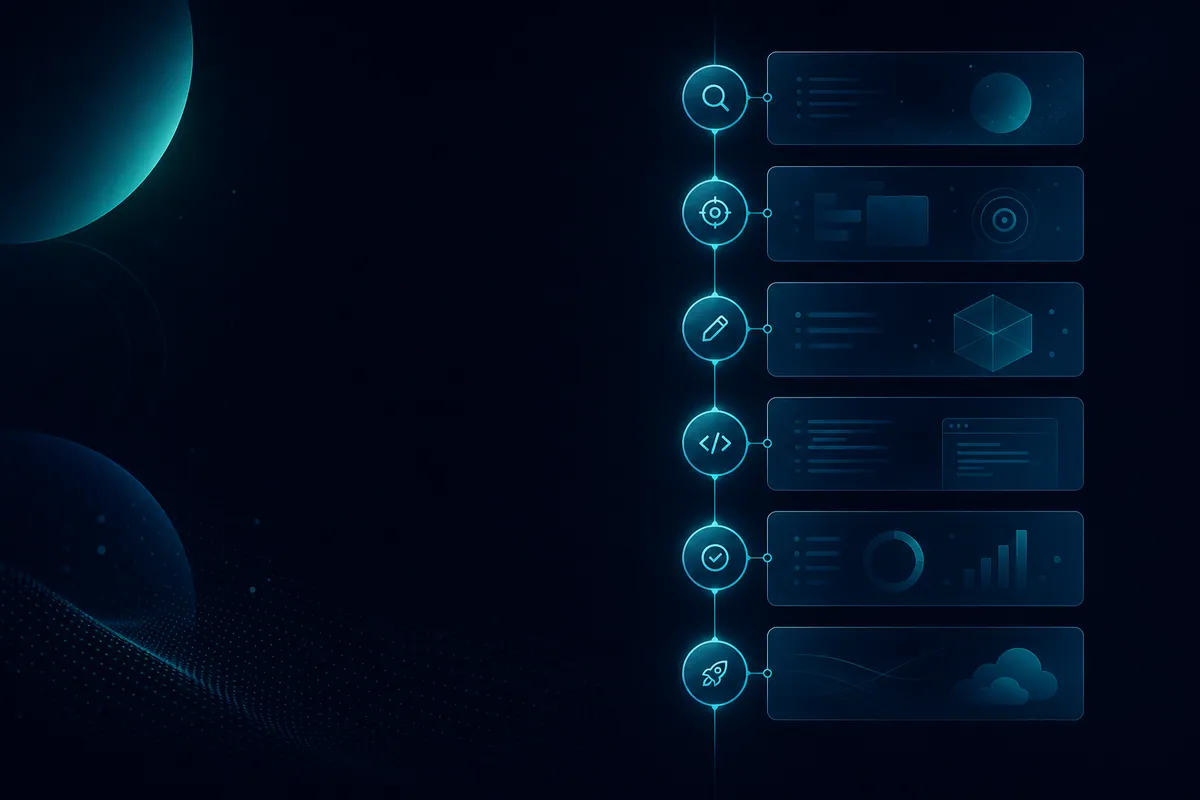
Six delivery steps mapped to Analyse, Design, Develop and Support
Why this process
The process makes decisions, responsibilities and quality checks visible before technical work becomes expensive to change.
Written scope and checkpoints keep the project away from guesswork and late reinterpretation.
Milestones have reviewable outcomes, so progress is measured by accepted work.
Delivery includes architecture, documentation and a support path your team can continue with.
Route overview
Analyse, Design, Develop and Support become six working steps with clear inputs, outputs and decisions.
Steps 1-2
Understand the problem, users, constraints and success criteria.
Steps 2-3
Define scope, architecture, milestones and a workable plan.
Steps 4-5
Build, review, test and prepare the agreed solution.
Step 6
Maintain, improve and plan the next useful releases.
Delivery steps
Every step defines the goal, your input, our work, the output and the condition for moving forward.
Step 1
Output: Problem brief and decision contextGoal: Clarify the business problem, audience and decision expected from the first conversation.
Your input
A short description of the pain, users, timing or budget limits and existing systems.
Hamranik team work
We ask precise questions, separate assumptions from facts and record decision priorities.
Entry to next step: When the goal and main stakeholders are clear, analysis begins.
Step 2
Output: Workflow, role and success mapGoal: Model users, workflows, constraints, exceptions and measurable success criteria.
Your input
Current process examples, roles, edge cases, important data and success indicators.
Hamranik team work
We map the workflow, list risks and propose a realistic boundary for the first version.
Entry to next step: After the first-version boundary is agreed, a written proposal can be prepared.
Step 3
Output: Scope, milestone and schedule proposalGoal: Make scope, assumptions, milestones and delivery plan explicit and reviewable.
Your input
Confirmation of priorities, approximate budget and the final decision owner.
Hamranik team work
We document milestones, assumptions, risks, outputs and a practical schedule.
Entry to next step: Once scope and checkpoints are accepted, design and development start.
Step 4
Output: Reviewable increments and maintainable architectureGoal: Build the solution in reviewable increments with maintainable engineering choices.
Your input
Timely feedback on demos, change priorities and access to systems or sample data.
Hamranik team work
We implement architecture, interface and business logic in increments that can be checked.
Entry to next step: When agreed scenarios are ready for validation, testing and handover begin.
Step 5
Output: Handover package, acceptance scenarios and documentationGoal: Validate agreed scenarios, resolve findings and make the delivery understandable.
Your input
Participation in acceptance, confirmation of findings and named access owners.
Hamranik team work
We run functional and acceptance checks, fix findings and prepare the handover package.
Entry to next step: After formal acceptance, the support and improvement path is activated.
Step 6
Output: Maintenance plan and improvement backlogGoal: Continue maintenance, bug resolution and future capability planning with a clear route.
Your input
Prioritised issue reports, real user feedback and improvement priorities.
Hamranik team work
We manage technical response, stability monitoring and short improvement cycles.
Entry to next step: Collaboration continues through measured improvement cycles.
Outcomes
The result is not only finished code. It is shared scope, visible progress and a delivery your business can maintain.
Everyone understands what is included in version one, what is not and which assumptions drive the plan.
Milestones produce reviewable work so quality and alignment can be corrected during the project.
Usage, access, scenarios and support responsibilities remain clear after delivery.
Decision checkpoints
Checkpoints prevent uncertainty from accumulating; each approval is a conscious move to the next stage.
01
After the first discussion, we confirm the problem, audience and expected decision.
02
After analysis, the MVP boundary, assumptions and success criteria are accepted.
03
Before development, milestones, outputs, responsibilities and calendar are finalised.
04
During the build, each reviewable part is approved or adjusted before risk grows.
05
At the end, agreed scenarios pass and the handover package is formally accepted.
Your role
Good software comes from precise discussion and timely decisions. Your role is part of delivery, not a side activity.
One person or a small group confirms scope, priorities and milestone acceptance.
Current process examples, roles, exceptions and sample data are available.
Reviews and test findings are answered within the agreed window so the project does not stall.
New requests are assessed with their effect on time, budget and scope.
Useful preparation
What we intentionally avoid
Transparency is also about what we do not start without the right conditions.
We do not start building before the version-one boundary and success criteria are clear.
Important changes must show their effect on time and priority instead of quietly entering the backlog.
A project is not called finished without agreed scenarios and formal acceptance.
The first version should solve the core pain; secondary capabilities are planned for later releases.
Continue exploring
These pages help you build a fuller picture before the first conversation.
Web applications, APIs, automation and consulting.
Operational systems shaped around real workflows.
From process modelling to traceable workflows.
Examples of reviewable software outcomes.
Experience, approach and quality standards.
What to clarify before starting a software project.
When a process is ready to become software.
Start a conversation about the next step.
FAQ
These answers address scope, timing, client role, support and project fit.
Next step
In the first conversation we review the problem, priorities, risks and the most practical next step without rushing into a vague scope.